LASIK eye surgery
What is LASIK eye surgery?
LASIK is a laser eye surgery that improves vision by reshaping the cornea, so light focuses correctly on the eye. It helps reduce or eliminate the need for glasses or contact lenses.
LASIK is commonly used to correct:
- Nearsightedness (myopia)
- Farsightedness (hyperopia)
- Astigmatism
LASIK is a personalized procedure.
Based on your eyes and prescription, one of several LASIK options may be recommended.
Book your free consultation to find out which option is right for you.
Wavefont-Optimized LASIK
This procedure uses detailed measurements of the curvature of the front surface of your eye to provide a laser treatment that is completely personalized for your eyes and vision correction needs.
Wavefont-Optimized LASIK uses much more detailed information than a conventional eyeglasses prescription to program the excimer laser that reshapes your eye during the vision correction procedure. The technology used for Wavefront-Optimized LASIK makes the procedure superior to a standard LASIK procedure in that it uses advanced technology to take precise and exact measurements of the characteristics of your eyes, which allows for a more customized treatment and ensures clear and sharp vision.
Wavefront-Optimized LASIK uses advanced technology to create a topological map of your individual cornea. Measuring the aberrations in your cornea’s shape and texture and customizing the laser to treat all these aspects has shown to improve vision clarity, night vision and the ability to see contrasting colors.
This procedure can be combined with All-Laser LASIK – a version of the procedure where the flap created on the surface of your cornea is performed using a laser instead of a microkeratome.
- More patients are candidates: Wavefront-Optimized LASIK allows for the correction of vision in a greater number of patients, including those with higher prescriptions and even those who may have been deemed non-candidates in the past.
- Better quality of vision: Wavefront-Optimized LASIK can, in many cases, improve the quality of both day and night vision compared to standard treatments. The laser is capable of treating people with larger pupils and is better for night time vision quality. It also minimizes the risk of night time glare and haloes. Wavefront-Optimized LASIK results in a corneal shape that is closer to the normal curvature of the natural eye, providing better quality for both day and night vision.
- Increased accuracy and safety for better results: Wavefront-Optimized LASIK removes 20%-30% less corneal tissue, which is healthier and safer for the eye. Wavefront-Optimized LASIK is also particularly beneficial for patients with thinner-than-average corneas, larger pupils, or higher prescriptions.
Contoura LASIK
Contoura LASIK, also known as topography-guided LASIK, is the latest FDA-approved LASIK eye surgery technology available in the U.S., offering patients a highly advanced, precise, and individualized LASIK treatment.
Like wavefront-optimized LASIK, topography-guided LASIK offers patients a greater degree of individual personalization. However, the main difference between topography-guided LASIK and other laser eye surgery procedures is that topography-guided LASIK addresses both the shape of the eye, and the surface of the cornea.
The advanced technology offers surgeons a precise, detailed mapping of a patient’s cornea, which allows for customized care for each eye of each patient. More than 22,000 unique elevation points on the cornea are analyzed which is then used to direct the laser beam to correct the minute variations of curvature at each point. The precision and accuracy of Contoura reduces the risk of visual side effects, including nighttime glare and light sensitivity.
Torography guided LASIK can be combined with All-Laser LASIK – a version of the procedure where the flap created on the surface of your cornea is performed using a laser instead of a microkeratome.
All-Laser LASIK
This LASIK procedure uses a femtosecond laser to create the corneal flap, instead of a microkeratome. It can be combined with either Standard or Custom LASIK.
With traditional LASIK, a precision instrument called a microkeratome is used to create a thin flap on the cornea (the clear front part of the eye). The protective flap created is then lifted to allow for the application of laser energy beneath it. The laser reshapes the cornea for vision correction. After laser treatment, the protective flap is re-placed and begins healing naturally.
An alternate method of creating a LASIK flap is through the use of a femtosecond laser also known as “blade-less,” “blade-free” or “all-laser.” This improvement in technology represents an innovative technique used to prepare the cornea for laser vision correction surgery.
There are numerous advantages to the All-Laser LASIK procedure when it comes to both patient candidacy and results. This type of surgery allows us to treat patients who would otherwise not be candidates for a standard LASIK procedure, including people with thinner-than-average corneas, larger-than-average pupils, and greater-than-average prescriptions. Additionally, patients are sometimes more comfortable knowing that this type of laser eye surgery does not involve the use of a blade.
Our clinical team will guide you through the differences and help determine the best option for your eyes.
Benefits of LASIK
- Proven, long-term results
- Procedure is usually quick and virtually painless
- Most patients are back in action within 24 hours
- Freedom from the hassles of glasses and contacts
LASIK surgery steps
The procedure generally requires 10 minutes of operating room time, during which the laser is used for less than a minute on each eye.
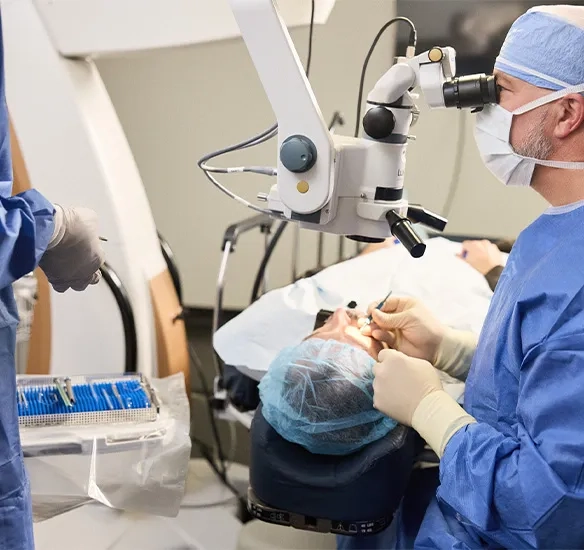
The LASIK procedure involves two steps:
A precise flap-making instrument known as a femtosecond laser (used in the All-Laser LASIK procedure) is used to create a thin flap of corneal tissue. This flap is raised and laid back but still attached to the cornea, in preparation for the actual laser vision correction procedure.
For the second step of the procedure, the surgeon will perform Advanced Custom Wavefront LASIK. An excimer laser is used to reshape the cornea by removing tissue from its middle layer.
The LASIK procedure offers extremely fast recovery: within hours of the surgery, the flap has usually begun to heal. Most patients are able to resume day-to-day activities just 24 hours after the surgery.
What patients say about LASIK
From initial consultations to post-surgery results, these patient experiences offer insight into what the LASIK journey can look like.
It's your turn! Take the next step:
LASIK safety and results
Is laser eye surgery safe? For more than 25 years, millions of patients worldwide have enjoyed the freedom that a vision correction procedure can offer. LASIK is widely accepted by surgeons as the safest elective medical procedure in today’s modern medicine.
FAQs
Am I a good candidate for LASIK?
Most adults over 18 with a stable prescription are candidates. Even those with thin corneas or high prescriptions often qualify for alternative procedures like PRK. Book a free consultation to determine your eligibility.
Does LASIK eye surgery hurt?
No. LASIK is virtually painless. We use numbing eye drops to ensure total comfort throughout the 10-minute procedure. You may only feel a slight sensation of pressure for a few seconds.
What is the recovery time after LASIK?
Recovery is remarkably fast. Most patients return to work and daily activities within 24 hours. While vision may be slightly hazy initially, functional clarity is typically achieved by the next morning.
Could I go blind from LASIK?
No. There has never been a reported case of blindness from LASIK at our clinics. It is one of the safest elective procedures in the world, with over 2 million surgeries performed at LASIK MD.
Is LASIK eye surgery permanent?
Yes. LASIK permanently reshapes the cornea to correct your current vision. While it provides lifelong correction for nearsightedness or astigmatism, it does not prevent natural, age-related vision changes like presbyopia.
How much does LASIK cost in North America?
LASIK MD offers a Lowest Price Guarantee with flexible financing options to fit any budget. Final costs are based on your prescription and chosen technology. Book a free consultation for a personalized price quote.
What is the difference between LASIK and PRK?
LASIK involves creating a small corneal flap for a faster recovery, whereas PRK (Photorefractive Keratectomy) is a flapless procedure that treats the surface. Both offer identical visual results; PRK is often recommended for patients with thinner corneas.
Am I a candidate for LASIK if I have thin corneas?
It depends, but usually PRK is the recommended alternative. While LASIK requires a corneal flap, PRK is a flapless procedure that preserves more tissue - ideal for thinner corneas. We will provide an accurate assessment during your free consultation.
What is All-Laser LASIK?
All-Laser LASIK uses a high-precision femtosecond laser instead of a manual blade to create the corneal flap. This advanced technology offers enhanced safety, greater flap precision, and a highly customized treatment plan.
LASIK facts, history, and common questions
If you’d like to explore LASIK in more detail, these resources provide additional context, facts, and background.
Myths and facts about LASIK
Don’t fall for the misconceptions regarding LASIK. Below, we separate fact from fiction by debunking some of the biggest myths about LASIK.
Myth: The procedure will hurt
Fact: LASIK is not painful
Read more
Most of our patients say they feel nothing more than a minor sensation during laser vision correction, if anything at all. The most typical sensation felt is a bit of pressure on the eye and nothing more. We properly prepare you before your procedure by giving you numbing eye drops to ensure that the experience is as painless as possible.
Myth: The recovery period is long
Fact: Most patients are back in action in 24 hours
Read more
The recovery period for most people following LASIK is short. Most of our patients are back to their normal day to day routine 24 hours after their procedure.
Myth: I can go blind
Fact: No one has gone blind after a LASIK MD procedure
Read more
LASIK MD surgeons have collectively performed more than 2 million procedures and no one has ever gone blind. Our track record of safety speaks for itself.
Myth: LASIK is simply too risky
Fact: Unquestionable safety
Read more
LASIK is widely considered to be one of the safest elective procedures in modern medicine. The recovery period is also smooth – the vast majority of complications are rare, minor, and treatable. The procedure also yields high levels of patient satisfaction. Isn’t it time you were one of those happy patients?
Myth: I'm too young (or old) to undergo a procedure
Fact: We treat patients aged 18 to 75
Read more
We treat patients 18 years of age and older. You don’t have to wait to be of a certain age in order to be considered a candidate for one of our procedures!
Myth: LASIK can only treat one specific eye condition
Fact: Our procedures can treat multiple conditions (including astigmatism)
Read more
Our procedures are designed to treat multiple eye conditions, including myopia (nearsightedness), hyperopia (farsightedness), astigmatism and presbyopia. For example, if you are myopic with some astigmatism, we can help.
Myth: The procedure is too scary to undergo
Fact: We take your comfort and safety very seriously
Read more
Our mission is to ensure that your time with us is as comfortable and easy as possible from start to finish. From the moment you step into a LASIK MD clinic, we make it our mission to answer all of your questions, walk you through your options and work to ensure that any fears or doubts you may have are addressed. We’ve also developed enhanced safety protocols to ensure the highest level of safety when you visit us.
Myth: The results of the procedure don't last long
Fact: Our procedures are designed to deliver long-lasting results
Read more
Our procedures are designed to treat common eye conditions in a long-lasting manner, ensuring that you can enjoy the benefits of laser vision correction for a prolonged period of time. LASIK has been performed for over three decades and countless patients have been happy with their long-term visual outcomes.
Myth: Contact lenses are much safer than LASIK
Fact: Your safest bet? Let go of the lenses
Read more
Maybe you’ve heard that contact lenses are ultra-safe, but time and time again, research has shown that long-term use of soft contacts is actually much riskier than LASIK. The potential for infection is high with daily contact lens wear: one person in every 100 contracts a potentially serious eye infection due to improper cleaning and wearing habits. LASIK, on the other hand, has a lower risk, with only one person out of every 1,500 developing an infection following their procedure—and if such occurs, most can be easily treated.
The history of LASIK
Father Waclaw Szuniewicz, considered to be a pioneer in early refractive surgery, first experimented with the changing the shape of the cornea.
Professor José I. Barraquer introduced a technique he coined keratomileusis (which means “sculptured cornea” in Greek). This procedure removes, reshapes and finally inserts the corneal discs into the patient’s eye, thereby laying the groundwork for what would eventually become refractive surgery.
A team at IBM developed the very first excimer laser, a laser that emits pulses of ultraviolet light—this technology would eventually be refined and used to correct vision.
Scientists practiced the first LASIK procedure on a cow’s corneal tissue.
A German ophthalmologist revolutionized the vision care industry, becoming the first to use an excimer laser on human eyes.
Dr. Steven Trokel first introduces the photorefractive keratectomy (PRK) procedure. In the same year, he patented the first excimer laser intended exclusively for vision correction, performing the first surgery on a patient’s eyes in 1987.
American physician Dr. Gholam Peyman described a theoretical surgical method of modifying the corneal curvature of the eye. This procedure involved cutting a flap in the cornea, pulling the flap back to expose the corneal bed and reshaping the exposed surface with an excimer laser.
Dr. Ioannis Pallikaris from Greece discovered that by combining the two aforementioned techniques, patients could expect achieve high rates of success along with great improvement to their vision. Dr. Pallikaris called the procedure LASIK—an acronym for laser-assisted in situ keratomileusis.
The excimer laser to correct myopia and astigmatism was approved by Health Canada in 1990.
Dr. Stephen Slade and his colleague, Dr. Stephen Brint, performed what is now known as LASIK for the first time in the United States.
PRK is approved by the FDA; back then, the procedure was originally developed as a measure to treat myopia. But as the procedure was improved upon over the years, its capacity to correct vision grew as well, helping to treat patients who were farsighted or had astigmatism.
Newer, gentler microkeratomes (flap-creation devices) were designed to allow for the creation of very thin LASIK flaps and also made it possible to create flaps on corneas with fragile surfaces.
LASIK was approved by the FDA.
Femtosecond technology emerged as an alternative method of flap creation. For patients with thinner-than-average corneas, larger-than-average pupils and greater-than-average prescriptions, femtosecond lasers begun to be used in a procedure called All-Laser LASIK, removing the use of the microkeratome altogether—this is sometimes called “bladeless” LASIK.
The FDA approved the use of Customized Wavefront LASIK, the most commonly-seen type of laser vision correction today.
Procedure availability varies by LASIK MD clinic and is subject to factors such as location, medical expertise, and patient eligibility as determined by a physician. Please contact your local clinic to confirm the availability of a specific procedure.