Blog

LASIK vs. EVO ICL: Which vision correction procedure is right for you?
If you’ve been considering vision correction, you’ve likely heard of LASIK. But there’s another innovative option gaining popularity called EVO ICL. Both procedures offer life‑changing benefits, but they differ in how they work and who they’re best suited for.
This guide will break down the key differences between LASIK and EVO ICL so you can make an informed decision about your vision care.
What is LASIK?
LASIK (laser-assisted in situ keratomileusis) is a laser eye surgery that reshapes the cornea to correct refractive errors such as nearsightedness (myopia), farsightedness (hyperopia), and astigmatism.
- How it works: A laser gently removes a precise amount of corneal tissue to improve how light focuses on the retina.
- Ideal candidates: People with mild to moderate prescriptions and healthy corneas.
- Recovery time: Most patients experience noticeably clearer vision within 24‑48 hours.
LASIK is highly effective and safe, but it’s not suitable for everyone, especially those with thin corneas, chronic dry eye, or very high prescriptions.
What is EVO ICL?
EVO ICL (implantable Collamer® lens) is an advanced, minimally invasive procedure that works with your natural eye, rather than reshaping the cornea.
Instead of removing tissue, a biocompatible lens is inserted behind the iris and in front of your natural lens, offering a reversible and long-term vision correction solution.
Benefits of EVO ICL
- Corrects moderate to very high prescriptions that LASIK may not treat
- The lens is completely removable, providing flexibility if your vision changes in the future
- Quick procedure with minimal recovery time
- Most patients notice clearer vision immediately after surgery
- Built-in UV protection to help safeguard your eyes
With millions of lenses implanted worldwide, EVO ICL is a proven and safe alternative to laser eye surgery
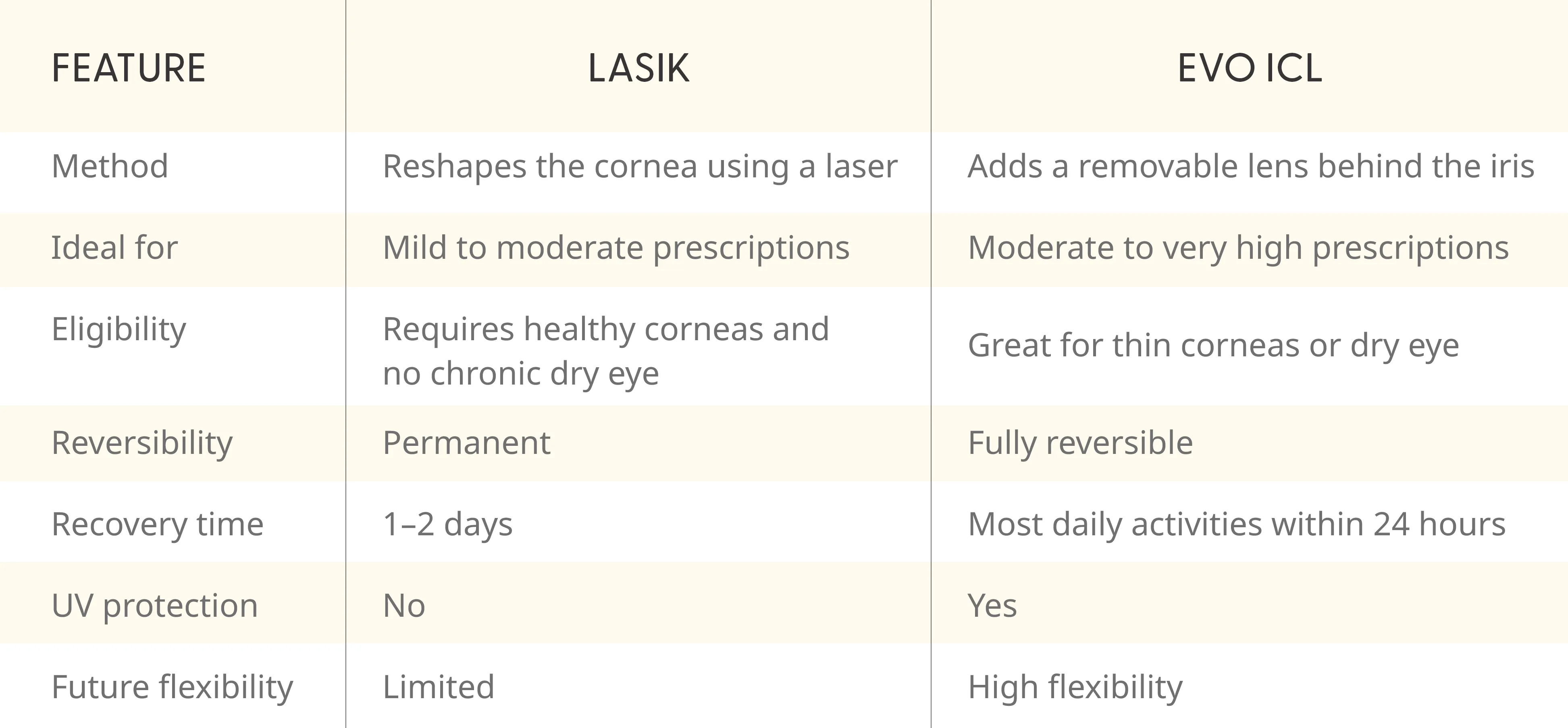
Key differences: LASIK vs. EVO ICL
Who is EVO ICL right for?
EVO ICL is an excellent option for adults who:
- Have moderate to high myopia or high hyperopia
- Have thin corneas or chronic dry eyes
- Are not eligible for LASIK or PRK
- Want a long-term, reversible solution with proven safety
How is EVO ICL done?
The EVO ICL procedure is quick and minimally invasive, typically taking 20‑30 minutes.
Here’s what you can expect:
- Preparation: Numbing and dilating eye drops are applied.
- Lens insertion: A tiny incision is made at the base of the cornea, and the lens is placed behind the iris.
- Positioning: The lens is carefully adjusted for optimal vision correction.
- Immediate results: Many patients notice clearer vision right away.
- Recovery: You’ll return to most daily activities within 24 hours but must arrange for someone to drive you home.
- Follow-up care: A check-up is scheduled the next day, followed by periodic follow‑ups.
For hyperopia patients, a minor preparatory step called laser peripheral iridotomy (LPI) is needed 1–4 weeks before surgery. This ensures proper fluid drainage and intraocular pressure regulation.
What procedure should I choose?
Both LASIK and EVO ICL deliver excellent results, but the best choice depends on your unique vision needs and eye health.
- Choose LASIK if you have a mild to moderate prescription, healthy corneas, and no chronic dry eye.
- Choose EVO ICL if you have a higher prescription, thin corneas, or simply want a reversible option.
At LASIK MD, our team of vision correction experts will help determine which procedure is right for you through a comprehensive eye assessment.
Schedule a free consultation at LASIK MD to explore whether LASIK or EVO ICL is the perfect fit for your lifestyle and vision goals.

Reviewed by the LASIK MD Editorial Team